

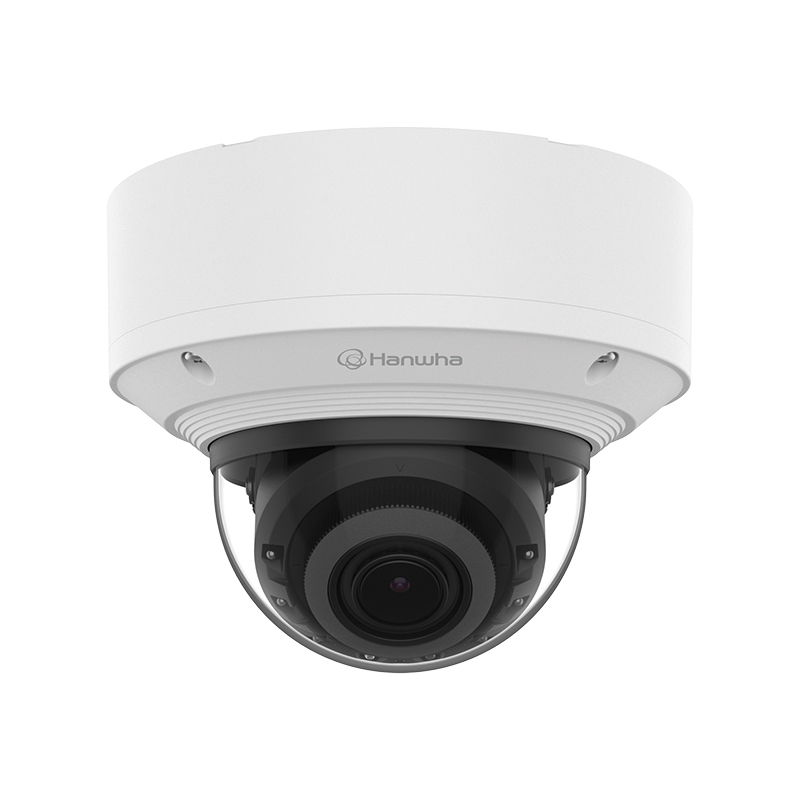
The XND-A8085RV is a 5MP indoor vandal-resistant network dome from the Wisenet 9 range. Built around a 1/2.8-inch CMOS sensor and 3.6–9.4mm motorised varifocal lens, it combines high-resolution imaging with integrated IR illumination and extensive edge-based AI analytics.
Despite being designated as an indoor camera, construction is substantial, with an aluminium body, IK10 impact rating and IP52 environmental protection. An integral microphone adds audio capability without requiring an external device.
The Wisenet 9 architecture uses separate processors for conventional camera operation and AI processing. Attention has also been paid to the optical design, with matt black material surrounding the lens and IR illuminators to reduce unwanted internal reflections from the dome.
Other notable specifications include 0.04 lux colour sensitivity, 120dB WDR, WiseIR illumination, AI object classification, BestShot capture and attribute metadata.
Getting started
A Quick Guide is supplied, with a more comprehensive PDF manual available for download from the product page on Hanwha Vision’s website.
The separate mount plate provides numerous fixing holes at different pitches and pitch-circle diameters, giving considerable flexibility when mounting directly to a surface or using one of the available mounting accessories.
Cable entry is through the rear of the camera case, with flexible silicone rubber grommets provided for different combinations of cables. A particularly useful plastic RJ45 cover fits around the network connector, allowing it to pass easily through the appropriate grommet.
The camera supports both PoE and PoE+, with PoE+ being the default. The power mode affects the available IR output, with Hanwha specifying a maximum IR range of 30m using PoE, increasing to 50m with PoE+. Alternatively, 12Vdc power can be used, requiring a suitable external PSU; Hanwha specifies 9.5W typical and 20.6W maximum consumption.
The camera module itself locates magnetically into the case with a reassuring thunk and then feels firmly retained while connections and adjustments are completed.
The clear dome cover appears to be of excellent optical quality. Straight-sided sections towards its base should reduce distortion when a ceiling-mounted camera is viewing close to the horizontal through the lower part of the dome. When replacing the cover, care must be taken to align its electrical contacts with those on the camera case; these appear to provide the connection for the integral microphone.
On first connection a password must be created. Eight or nine-character passwords require three of uppercase, lowercase, numeric and special characters; passwords of ten characters or more require two, while repeated and sequential keyboard characters are prohibited.
DHCP is supported, while in the absence of a DHCP server the camera defaults to 192.168.1.100.
Commissioning can be performed through the browser interface or by connecting a compatible USB Wi-Fi adapter to the USB-C port and using Hanwha’s Wisenet Installation smartphone app. An Edimax adapter connected through a USB-C OTG adapter worked without difficulty. Live video, motorised zoom, autofocus and image orientation are then available at the camera position, making initial alignment particularly convenient.
Read the full review in the September 2026 edition of PSi magazine
