

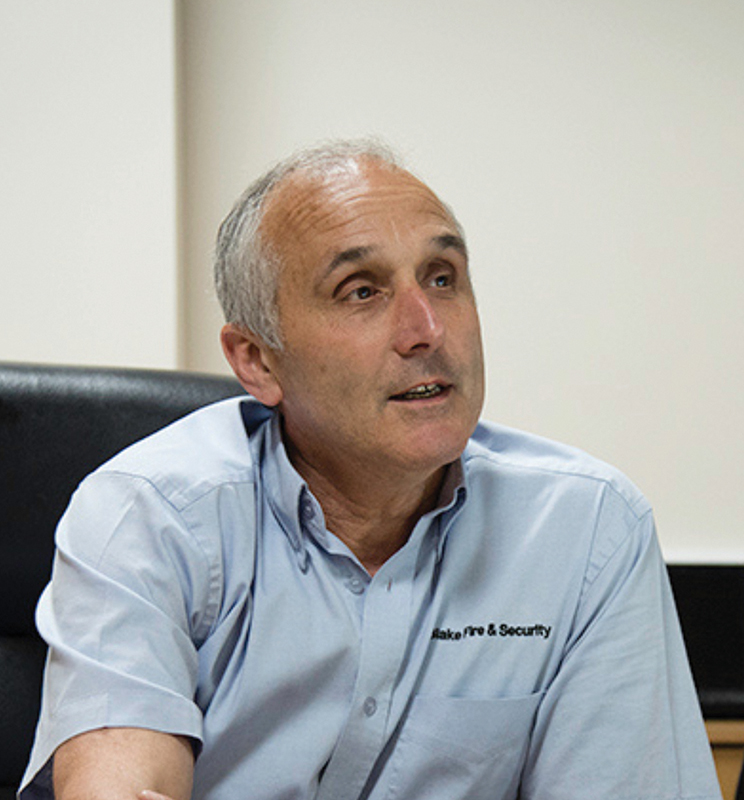
Ian Blake is the managing director of Blake Fire & Security Systems based in Southend-on-Sea, Essex. He has more than 20 years’ experience in fire and security and over four decades in the wider electrical and contracting industry.
What’s your company all about and what makes it stand out?
Blake Fire & Security is still very much a family-run business, and I think that makes a big difference. There aren’t so many of those left now, especially in this industry.
We cover a broad range of fire and security services, so for a lot of our clients we’re a one-stop shop. We work across fire alarms, intruder alarms, CCTV, access control, door entry, automatic gates, emergency lighting, fire extinguishers and fire doors. The security side is a very important part of what we do, but the strength of Blake’s is that we can look at the whole picture.
What also matters to us is the long-term relationship with the client. If someone has a maintenance contract with us, we are going to see them regularly. That gives us a chance to check that everything is working properly, but also to spot anything that might have changed. Regulations change, buildings change, risks change. If we see something that needs bringing to the customer’s attention, we tell them.
At the heart of it, it’s about keeping people safe and helping clients stay compliant. That’s what the work is really there for.
What kind of projects do you most enjoy working on?
The projects I enjoy most are the ones where we can provide a complete solution. That might be a new build, a school, a commercial site or a larger project where there are four or five systems that all need to work together.
It’s good when a client can come to us and say, “We need fire, access control, gates, CCTV and intruder alarms,” and we can look at how all those systems should connect. For example, access control may need to link to the fire alarm so doors release correctly in the event of a fire. Intruder alarms can link with gates, so when the alarm is set, the gates are locked or managed automatically.
That kind of project lets us use the full range of knowledge across the team. It’s not just installing individual pieces of equipment. It’s making sure the whole site works properly, safely and practically for the people using it.

Which technologies or products are exciting you right now?
For me, the exciting part is integration. It’s not always about one particular brand or one individual product. It’s about how different systems can work together to create a better overall result.
You might have Paxton access control, Texecom intruder alarms, CCTV, automatic gates and safety sensors all working as separate systems, but the clever part is making them talk to each other in the right way. On one gate, you might have several systems involved — the gate itself, the safety sensors, the CCTV, the access control and the intruder alarm. When it’s done properly, it makes life easier for the client and improves the level of protection.
There are very few single systems that will do absolutely everything. The value is in knowing different products well enough to bring them together. Sometimes that means getting two or three of our engineers together, knocking heads and working out the best way to make it all operate properly.
What’s the most rewarding part of your job?
Getting to the end of a job, handing it over and seeing that the client is happy is always rewarding. That is what you work towards.
But the other important part is the people who work here. I want our staff to be happy along the way. They don’t come to work to be upset, overworked or taken for granted. They come to earn a living, do a good job and go home in good health.
So, the rewarding part is two-sided. It’s the client being happy with the work, and it’s the team feeling looked after while they do it. Without good clients and good people, you haven’t got a business.
How does NSI certification make a difference to your business?
NSI gives independent verification. We can say we work to a high standard, but NSI comes in and inspects us. If we don’t uphold the standard, we risk losing that approval.
That makes a real difference. It keeps us sharp and makes sure we are working to the latest standards. They are stringent in what they do, and rightly so. They inspect the systems, the paperwork, the certificates and the way we operate. If something is not right, the question is not just “How do you fix it?” It is also “Why did it happen?” and “What are you putting in place to stop it happening again?”
That might mean extra training, better logging, clearer processes or bringing the engineers up to date on a particular issue. It’s all part of maintaining the standard.
I pushed for NSI in the early days because I believed it mattered. It took us a long time to get there, and it was hard work, but that is part of why the approval means something. It isn’t just a badge. It is an ongoing discipline.
As told to Jo Shaer of Lollipop Local, the fire and security marketing agency for third-party certified installers Blake Fire & Security Systems has worked with Lollipop Local since 2016.
Read the full interview in the September 2026 edition of PSi magazine
